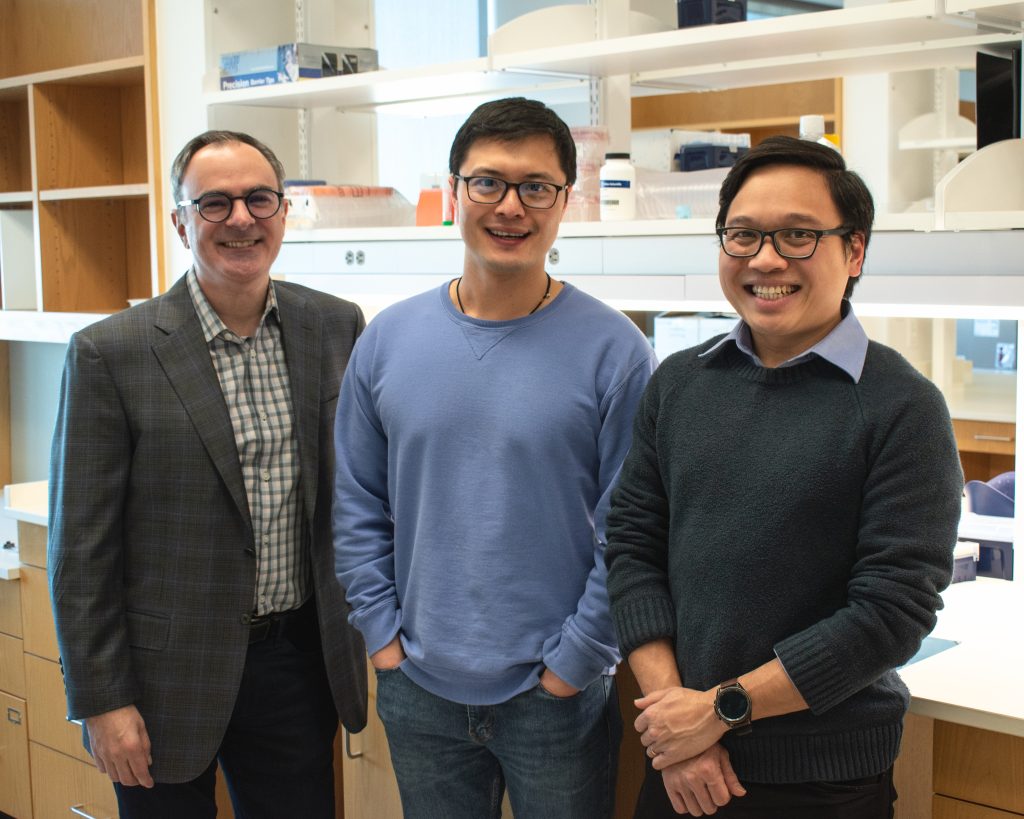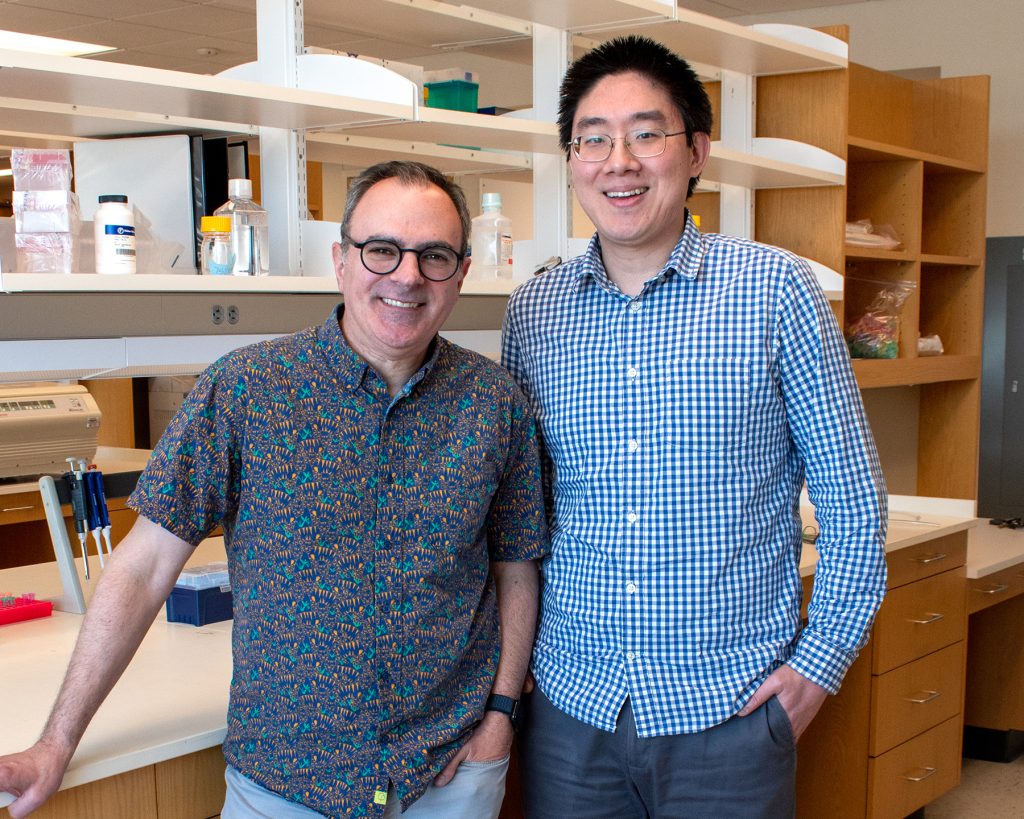
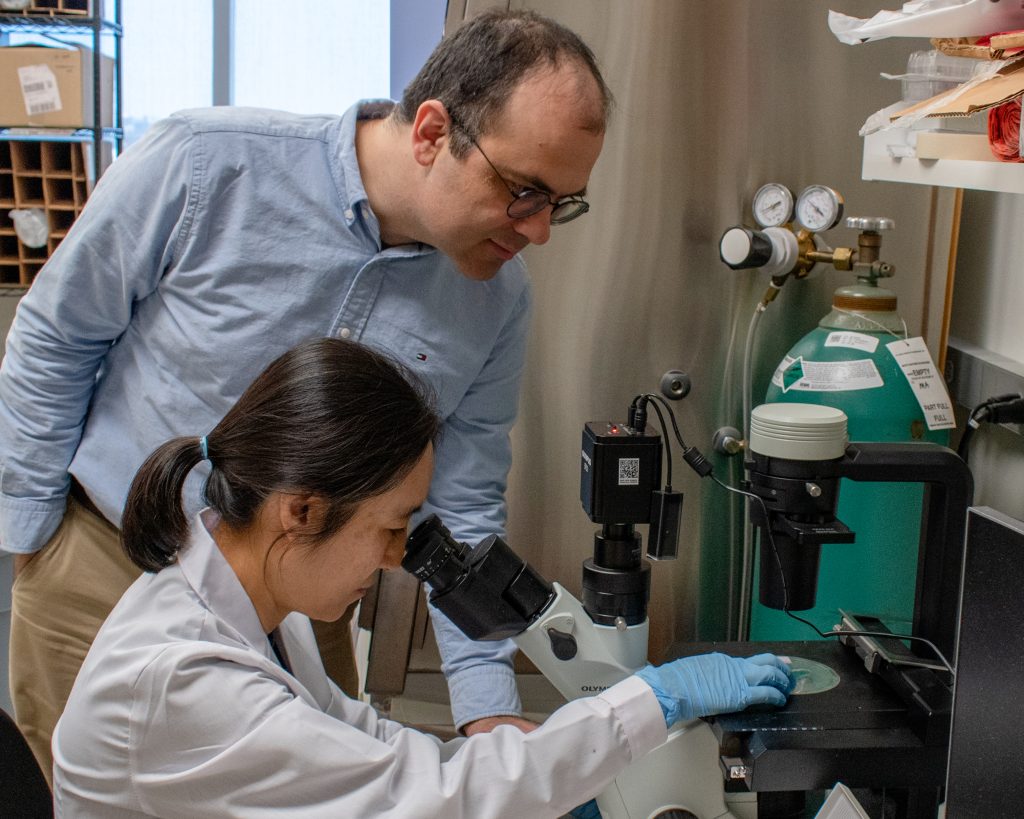
Michalis Agathocleous, Ph.D., Assistant Professor in CRI and of Pediatrics, and Ji Hyung Jun, Ph.D., Agathocleous Lab Senior Research Scientist.
Agathocleous Lab, collaborators discover vitamin C deficiency can benefit animals by depriving vitamin from parasitic worms
DALLAS – Dec. 23, 2025 – Scientists at Children’s Medical Center Research Institute at UT Southwestern (CRI) have discovered a benefit of vitamin C deficiency: protection from a major parasitic disease. Their research suggests an explanation for the loss of the ability to synthesize vitamin C in some animals, including humans.
Ascorbate, better known as vitamin C, is not required by most animals because they can synthesize it using a gene called L-Gulonolactone Oxidase (GULO). But GULO was lost in humans and some other species as they evolved, making ascorbate a vitamin – a necessary nutrient that must come from diet. Most scientists view this as a neutral trait loss because there have been no known benefits to vitamin C deficiency.
New CRI research published today in the Proceedings of the National Academy of Sciences challenges this view by showing that losing the ability to synthesize vitamin C and becoming vitamin C deficient protects animals infected with schistosomes, a type of parasitic flatworm that needs vitamin C from its host to reproduce.
The research was conducted by the lab of Michalis Agathocleous, Ph.D., Assistant Professor in CRI and of Pediatrics, in collaboration with the labs of Jipeng Wang, Ph.D., Assistant Professor at Fudan University in Shanghai, and James J. Collins, Ph.D., Professor of Pharmacology at UT Southwestern and a Howard Hughes Medical Institute Investigator.
Vitamin C deficiency classically causes scurvy. Dr. Agathocleous discovered in 2017 that vitamin C deficiency promotes myeloid leukemia development, suggesting that the disadvantages of deficiency extend beyond scurvy into cancer development.
Other scientists have shown that vitamin C synthesis is an ancient metabolic pathway lost not only in some animals, but also in many parasites. Then in 2019, Drs. Wang and Collins discovered ascorbate was one of the vital elements necessary for schistosomes to lay eggs in a petri dish.
Dr. Agathocleous said these discoveries led him to hypothesize that a host deficient in vitamin C could be protected from parasites that require vitamin C but cannot synthesize it.
Ji Hyung Jun, Ph.D., Agathocleous Lab Senior Research Scientist, and CRI researchers studied normal mice, which can naturally synthesize ascorbate, compared with mice missing the Gulo gene. They found most normal mice infected with schistosomes died from schistosomiasis, but only 5% of mice without the Gulo gene died. Intermittent vitamin C intake reduced morbidity and mortality from schistosomiasis while preventing scurvy.
“Our work changed my view of vitamins. Vitamins have been studied for over a hundred years for their possible benefits, and vitamin deficiencies are, by definition, harmful,” Dr. Agathocleous said. “This research shows that having transient deficiency in a vitamin can be beneficial in an animal infected with a pathogen that requires the vitamin.”
Nearly 250 million people are affected with schistosomiasis, the disease caused when schistosomes penetrate human skin via contaminated water. Schistosomes live, sometimes for decades, in human blood vessels near the liver.
“We think the advantage of deficiency comes from the different timescales over which the worms need vitamin C versus the host,” Dr. Agathocleous said. “Worms lay eggs every day, whereas host disease due to deficiency takes months to develop. So, on balance, there is a benefit for an infected animal to be transiently deficient in vitamin C.
“It is still possible that the loss of vitamin C synthesis was evolutionarily neutral, since we don’t have the tools to formally test for positive selection of GULO loss in ancient primates,” Dr. Agathocleous added. “But because schistosomiasis is so prevalent, and the survival benefit for infected animals is so strong, our results could explain why GULO was lost and ascorbate became a vitamin.”
Future Agathocleous Lab research will continue to investigate the role of vitamin C and effects of its deficiency in human diseases, including parasites and myeloid leukemia, a type of blood cancer that starts in the bone marrow and affects white blood cells.
This research was funded by the Cancer Prevention and Research Institute of Texas (CPRIT), the American Society of Hematology, the Moody Foundation, The Welch Foundation, the National Institutes of Health, the National Key Research and Development Program of China, and the Fund of Fudan University and Cao’ejiang Basic Research.
Dr. Agathocleous is a CPRIT Scholar. He is also a member of the Cellular Networks in Cancer Research Program at the Harold C. Simmons Comprehensive Cancer Center at UT Southwestern.
Dr. Collins holds the Jan and Bob Bullock Distinguished Chair for Science Education and the Jane and Bud Smith Distinguished Chair in Medicine and is a Rita C. and William P. Clements, Jr. Scholar in Biomedical Research.
More thoughts from study researchers:

Dr. Jun: “This study introduces new insights of micronutrient evolution, and it will be interesting to know if GULO loss in other animal species is also associated with defense against parasite infection.”

Dr. Wang: “Parasites are remarkably clever. Schistosomes, for example, depend on vitamin C from their hosts to drive one of their most essential biological functions: producing eggs to sustain their populations. After millions of years of evolution, parasites have perfected diverse strategies to interact with – and often exploit – their hosts. There is still much we have yet to uncover about how they do this.”

Dr. Collins: “This represents a fundamental advance in schistosome biology. The work demonstrates that a single essential nutrient can dramatically modify disease outcomes, underscoring the critical, but understudied, role of host nutrition in schistosomiasis. Given the high prevalence of malnutrition in endemic regions, these findings point to new conceptual and practical approaches for understanding disease burden in vulnerable human populations.”
###
About CRI
Children’s Medical Center Research Institute at UT Southwestern (CRI) is a joint venture of UT Southwestern Medical Center and Children’s Medical Center Dallas. CRI’s mission is to perform transformative biomedical research to better understand the biological basis of disease. Located in Dallas, Texas, CRI is home to interdisciplinary groups of scientists and physicians pursuing research at the interface of regenerative medicine, cancer biology, and metabolism – relentless discovery toward the treatments of tomorrow.
X/Twitter | Blue Sky | LinkedIn | Instagram | YouTube | Facebook
About UT Southwestern Medical Center
UT Southwestern, one of the nation’s premier academic medical centers, integrates pioneering biomedical research with exceptional clinical care and education. The institution’s faculty members have received six Nobel Prizes and include 24 members of the National Academy of Sciences, 25 members of the National Academy of Medicine, and 13 Howard Hughes Medical Institute Investigators. The full-time faculty of more than 3,200 is responsible for groundbreaking medical advances and is committed to translating science-driven research quickly to new clinical treatments. UT Southwestern physicians provide care in more than 80 specialties to more than 140,000 hospitalized patients, more than 360,000 emergency room cases, and oversee nearly 5.1 million outpatient visits a year.